

GHG emissions
We have kept track of our emissions since 2021. In 2025, emissions from our own operations (Scope 1 and 2) accounted for only a small proportion of our total emissions. The majority, above 99% of all emissions related to our operations, are generated in the company’s value chain (Scope 3). The most significant sources of emissions are electricity consumed during the life cycle of our machines and emissions caused by purchased goods and services. Our GHG emissions inventory covers Scope 1, 2 and 3 emissions and is based on the GHG Protocol standard.
Emissions from own operations
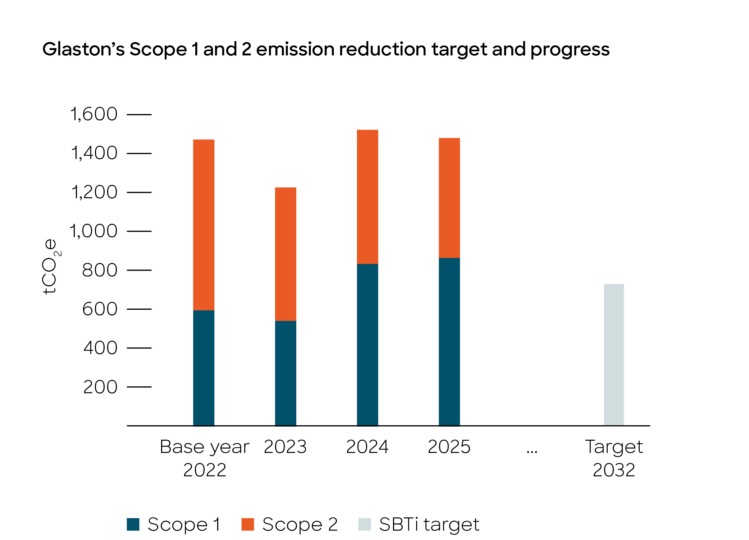
In our own operations, the majority of GHG emissions originate from the use of fossil fuels and district heating at our facilities. In order to reach our short-term absolute Scope 1 and 2 emission reduction target set for 2032, we plan to phase out natural gas and other fossil energy sources in our operations and to significantly increase the share of renewable energy. Starting from 2026, we have transitioned from fossil electricity to renewables in our Tianjin factory, which will help us reach our 2032 target.
Emissions from value chain
The most significant climate impacts from our operations are related to the use of sold machines, especially the electricity consumption of tempering machines. The tempering process, in which glass is heated to over +600 degrees Celsius and quickly cooled to room temperature, is highly energy intensive. Our annual Scope 3 emissions are significantly influenced by the types of glass processing solutions customers purchase and the availability of zero-emission energy in different market areas. Our product development is continuously focusing on improving the energy efficiency of machines. Automation and technological developments allow machines to efficiently optimize energy consumption in both the heating and cooling process, and new technologies can also be upgraded to existing production lines.
Generated waste accounts for less than 1% of the total Scope 3 emissions. Despite this, we are tracking waste generation internally. The primary aim is to prevent the generation of waste, and particularly the amount that ends up in landfills.