Climate action
Glaston’s environmental work is driven by the company’s Environmental and Climate Change Policy, which defines a commitment to systematic reduction of environmental impacts. Glaston recognizes its responsibility for the environmental and climate impacts caused throughout the company’s value chain and proactively seeks to prevent and mitigate potential environmental impacts and risks caused by its operations.
In line with its policy, Glaston aims to reduce carbon dioxide emissions in its own operations and value chain by focusing on energy savings and transitioning to low-carbon and renewable energy sources. Glaston is planning to phase out natural gas and other fossil energy sources in its operations in the long term and to significantly increase the share of renewable energy.
Glaston’s own operations, which mainly consist of the assembly of glass processing machinery, do not pose a significant risk of air, water or soil pollution. In Glaston’s activities most significant environmental impacts arise from energy consumption and related emissions. We operate in accordance with the ISO 9001 quality management system in all assembly and production units. In Finland, Glaston manages environmental issues in accordance with the ISO 14001 certified environmental management system.
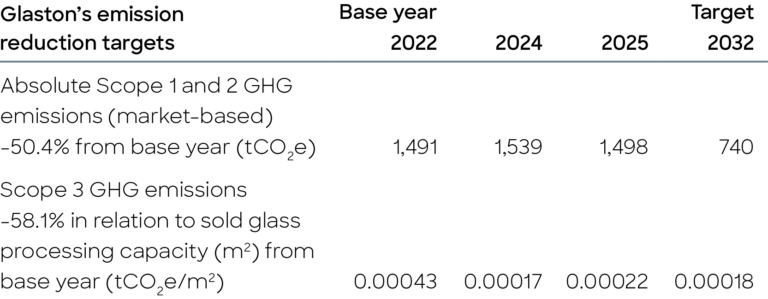
Glaston's emissions reduction targets
We have set short-term science-based emissions reduction targets and are committed to reducing our emissions from own operations as well as in the value chain. The targets are in line with the goal of limiting global warming to 1.5 °C and are validated by the Science-Based Targets (SBTi) initiative. The targets have been set for base year 2022.
We are committed to reducing our absolute market-based Scope 1 and 2 GHG emissions by -50.4% from base year 2022 and Scope 3 emissions by -58.1% in relation to sold glass processing capacity (m2) compared to base year 2022. The Scope 3 target is measured as an intensity of emissions per sold glass processing capacity and includes critical assumptions related to future changes in sales volumes, developments in customer demand and preferences, regulatory factors, and the deployment of new technologies.
To achieve these targets, Glaston has prepared a detailed emission reduction roadmap spanning to 2032. For Scope 1 and 2, the actions are based on reducing the use of natural gas and other fossil fuels in own operations and gradually increasing the share of renewable energy.
To achieve the target set for Scope 3, the company’s policy is to improve the energy efficiency of the products it sells, support customers in their emission reduction targets and implement measures to reduce emissions in other parts of the value chain, such as purchased goods and services.
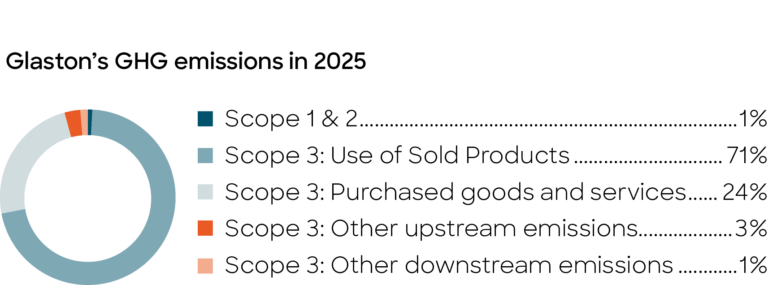
GHG emissions in 2025
Emissions from our own operations (Scope 1 and 2) cover only a small fraction of our total emissions. In 2025, emissions from Glaston’s own operations totalled 1,497 tCO2e (1,491 tCO2e in 2022), of which the use of fossil fuels (Scope 1) accounted for 59% and electricity and district heating (Scope 2) for around 41%.
The majority, over 99% of all emissions associated with our activities, arise in the company’s value chain (Scope 3). The most significant sources of emissions are the electricity consumed during the life cycle of our machines (71%) and the purchasing of products and services (24%). In 2025, our Scope 3 emissions totalled 176,065 tCO2 (Base year 2022: 685,073 tCO2).
Glaston’s annual Scope 3 emissions are significantly affected by the type of glass processing solutions that customers purchase. Glaston supplies its customers with different machines in different years, which is why absolute Scope 3 emissions can fluctuate significantly from year to year.