

Headline

Strategy and medium-term (3-5 years) strategic targets

Glaston sets medium-term strategic targets
Glaston’s Board of Directors has approved adjusted net sales and comparable return on capital employed (ROCE) targets and an extended target period for the strategic targets.
Since the previous strategy update in August 2021, there have been significant changes in the global economy and Glaston’s addressable markets started to soften in 2023. Due to these changes, the time for reaching the strategic targets has been modified to reflect the current expectations. Glaston has adjusted the timeframe for achieving the strategic targets from 2025 to the medium-term (3−5 years) except for the emissions reduction targets with a timeframe up to 2032.
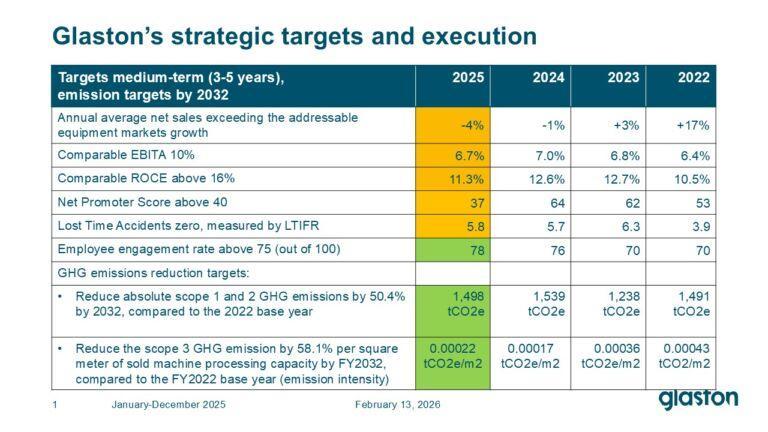
Glaston has also slightly updated the net sales target and expects the annual average growth to exceed the addressable equipment markets’ growth. The updated target for comparable return on capital employed (ROCE) is above 16%. The target for the comparable operating margin (EBITA) of 10% remains unchanged.
Glaston estimates that in 2025, the Architectural markets in China and EMEA stayed flat at the previous year’s lower level, while they declined in Americas and the rest of APAC. The mobility market in China returned to a more normal level after a record year in 2024, and elsewhere stayed flat.
Glaston’s medium-term (3-5 years) strategic targets:
- Annual average net sales growth (CAGR) exceeding the addressable equipment markets growth
- Comparable operating margin (EBITA) of 10%
- Comparable return on capital employed (ROCE) of above 16%
- Customer satisfaction score (Net Promoter Score, NPS) above 40.
- Group-wide zero lost time accidents target, progress measured by lost time accidents per million working hours (LTIFR)
- Employee Engagement target above 75 (out of 100)
- GHG emissions reduction targets:
- Reduce absolute scope 1 and 2 GHG emissions by 50.4% by 2032, compared to the 2022 base year (1,491 tCO2e)
- Reduce the scope 3 GHG emissions by 58.1% per square meter of sold machine processing capacity by FY2032 (emission intensity). Base year 2022: 0.00043 tCO2/m2
President & CEO's Review
CEO Miika Äppelqvist in the January-June 2026 report, published on August 12, 2026:
“In the second quarter, uncertainty in the global economy and geopolitical environment continued, and market conditions remained weak. In the Architectural market, activity in new machine investments remained limited, while demand for upgrades gained momentum. This was supported by customers’ increasing focus on improving the performance and extending the lifetime of their existing equipment, as well as by our commercial focus on upgrade opportunities. In the Mobility market, activity in China remained at a reasonable level.
In the second quarter, the level of order intake remained unsatisfactory. The order intake for tempering and laminating technologies increased slightly, whereas order intake for insulating glass technologies fell compared to the comparison period. Driven by demand for our pre-processing lines in China, order intake for Mobility, Display & Solar Technologies more than doubled from a weak comparison period. For Services, upgrade investments and activity increased in EMEA and especially in Americas, where major upgrade orders were received. Services order intake increased by 21%, and was the strongest for pre-processing upgrades in Glaston’s history. This development demonstrates the resilience of our installed base driven lifecycle business.
The Group’s low order intake in the second half of 2025 was reflected in net sales, which were down by 20% to EUR 41.5 million. In the second quarter, Services’ net sales represented 47% of total net sales. Comparable EBITA was EUR 2.7 million, down by 13%. Despite the significant decline in net sales, our comparable EBITA margin improved to 6.6%. Demonstrating the importance of our cost saving program, our EBITA margin was up compared to both the previous quarter (6.5%) and the corresponding period in 2025 (6.1)%. The program was launched almost a year ago, targeting annual run rate savings of EUR 6 million. Including both permanent and short-term actions, the target was met already by the end of the first quarter this year. We continue to maintain disciplined cost management to ensure our cost base remains sustainable also in the lower new equipment investment demand environment.
Following the transfer of production from Switzerland to China in 2025, we completed the sale of the Swiss property during the second quarter. The sales price amounted to EUR 9.9 million, generating a gain of EUR 7.8 million, further strengthening our financial position.
We enhanced our customer interface, and the EMEA + APAC market area organization was divided into two market areas: Europe, Middle East, Africa and India (EMEAI) and China & South East Asia (SEA). The renewed commercial structure reflects a focused move to simplify our operating model and to have leadership closer to our customers.
Glaston has a long tradition as a technology frontrunner. In the reporting period, our technology portfolio was further strengthened through the acquisition of selected intellectual property rights related to a unique local area coating concept. This technology offers interesting opportunities, aligned with our vision, to integrate more intelligence into glass. As a global technology forerunner, we also actively protect and enforce our intellectual property rights worldwide. Following the end of the reporting period, we confirmed the final settlement in a patent litigation matter concerning Glaston’s proprietary glass tempering technology. After a five-year process, the outcome reinforces the strength of our technology portfolio and our commitment to protecting innovations that create value for our customers.
Due to the uncertainty in the global business environment, we expect market activity to remain slow throughout the year. In this weak demand environment, our priority is to be close to our customers and to secure our order intake. At the same time, we remain focused on measures that are within our own control: disciplined cost management, operational reliability and value creation for our customers. In the first half of the year, our financial position improved. This strengthens our ability to invest in growth initiatives, while also maintaining resilience amid continued market uncertainty.”

Guidance
In the first half of 2026, the glass processing equipment markets were soft, and Glaston expects market activity to remain slow during the rest of the year. For the architectural glass processing equipment markets, a significant recovery is not expected in the near future. Driven by China, the mobility glass processing equipment market is expected to remain at the same level as in 2025. Supported by the installed base and continuous customer demand for lifecycle services, the service business environment is expected to continue at a good level.
In response to the weak market environment, Glaston continues its actions for improved efficiency, cost management, and selective growth opportunities, particularly in lifecycle services and targeted technology areas. Amid increased global economic unpredictability, higher-than-normal uncertainty is related to customers’ investment activity.
Glaston entered the year with a lower order backlog than in the previous year. Given the cautious market environment, Glaston Corporation estimates that its net sales will decrease in 2026 from the levels reported for 2025. Comparable EBITA is estimated to amount to EUR 9.0−11.0 million. In 2025, Group net sales totaled EUR 208.8 million and comparable EBITA was EUR 14.0 million.
(Published in the January-June report on August 12, 2026)
GLASTON’S OUTLOOK FOR 2026
(published in the Q1 2026 interim report on April 29, 2026)
In 2026, the glass processing equipment markets are expected to remain soft. Due to increased geopolitical tensions, a significant recovery for the architectural glass processing equipment markets is not expected in the near future. Driven by China, the mobility glass processing equipment market is expected to remain on the same level as in 2025. While the equipment markets remain soft, the service business environment is expected to remain resilient and at a good level, supported by the installed base and ongoing customer demand for lifecycle services.
In the current market environment, Glaston continues its actions for improved efficiency, cost management, and selective growth opportunities. Amid increasing global economic unpredictability, a higher-than-normal uncertainty is related to customers’ investment activity.
Glaston entered the year with a lower order backlog than the previous year. Given the cautious market environment, Glaston Corporation estimates that its net sales and comparable EBITA will decrease in 2026 from the levels reported for 2025. In 2025, Group net sales totaled EUR 208.8 million and comparable EBITA was EUR 14.0 million.
GLASTON’S OUTLOOK 2026
(as published in the financial statements release on February 13, 2026)
In 2026, Glaston expects the glass processing equipment markets to remain soft. The cautious development in the architectural glass processing equipment markets is expected to continue, with potential improvement only anticipated towards the second half of the year. Driven by China, the mobility glass processing equipment market is expected to remain on the same level as in 2025. For services, the markets are expected to develop positively.
In the current market environment, Glaston continues its actions for improved efficiency, cost management, and selective growth opportunities. As geopolitical tensions and global economic unpredictability continue, a higher-than-normal uncertainty is related to customers’ investment activity.
Glaston entered the year with a lower order backlog than the previous year. Given the cautious market environment, Glaston Corporation estimates that its net sales and comparable EBITA will decrease in 2026 from the levels reported for 2025. In 2025, Group net sales totaled EUR 208.8 million and comparable EBITA was EUR 14.0 million.
GLASTON’S OUTLOOK FOR 2025
(as published in the Q3 2025 interim report on October 30, 2025)
The cautious development in the architectural glass processing equipment market continued in the third quarter, and the market activity is expected to remain slow during the rest of the year. As part of Glaston’s actions to address the reduced market demand, the company has focused on improving organizational efficiency and cost management to ensure profitable performance. Further, due to the ongoing geopolitical tensions and uncertainty in the global business environment, a higher-than-normal level of unpredictability is related to customers’ investment decisions.
The lower order backlog and the advancement of some project acceptances to the third quarter will affect the development of Glaston’s fourth quarter net sales and comparable operating profit. Glaston’s outlook remains unchanged and the company estimates that its net sales and comparable EBITA will decrease from the level of the previous year. Glaston expects net sales to be EUR 206−215 million and comparable EBITA to amount to EUR 13.1−15.1 million. In 2024, Group net sales totaled EUR 217.9 million and comparable EBITA was EUR 15.3 million.
GLASTON’S OUTLOOK FOR 2025
(as published in the Half-Year financial report on August 8, 2025)
On July 22, 2025, Glaston announced a profit warning and lowered its net sales and comparable EBITA outlook for the full year 2025. The outlook remains unchanged since the announcement.
During the first half of the year, the softness of the Architectural market increased. The prevailing uncertainty in the market environment and the US tariff situation have increasingly affected customers’ investment decisions.
Glaston expects market activity to remain slow throughout the year. To mitigate the effects of weakening demand, Glaston will, in addition to the already ongoing cost-control measures, start actions to improve the company’s organizational efficiency and reduce costs to ensure profitable performance.
Glaston Corporation estimates that its net sales and comparable EBITA will decrease from the level of the previous year. Glaston expects net sales to be EUR 206−215 million and comparable EBITA to amount to EUR 13.1−15.1 million. In 2024, Group net sales totaled EUR 217.9 million and comparable EBITA was EUR 15.3 million.
Published on July 22, 2025:
Due to significantly lower demand in the second quarter and the architectural market showing no signs of significant recovery, Glaston lowers its net sales and comparable EBITA outlook for the full year 2025.
During the first half of the year, the softness of the architectural market increased. The prevailing uncertainty in the market environment and the US tariff situation have increasingly affected the customers’ investment decisions.
Glaston expects market activity to remain slow throughout the year. Market uncertainty and the extended decision-making times will impact the development of both net sales and comparable EBITA.
In addition to the already ongoing cost-control measures, Glaston starts immediate planning of further cost-reduction actions to mitigate the effect of the weakening demand.
Glaston Corporation estimates that its net sales and comparable EBITA will decrease from the level of the previous year. Glaston expects net sales to be EUR 206−215 million and comparable EBITA to amount to EUR 13.1−15.1 million. In 2024, Group net sales totaled EUR 217.9 million and comparable EBITA was EUR 15.3 million.
Outlook for 2025
(Published in the Q1/2025 report on May 6, 2025)
In 2025, the glass processing equipment markets are expected to remain soft. The architectural market shows no signs of significant recovery for this year. For mobility glass processing equipment, the market activity in China shows signs of a slowdown. Due to increasing global economic uncertainty, continued geopolitical tensions, and the risk of a global trade war, a higher-than-normal level of uncertainty exists concerning customers’ decision-making.
Given the sluggish greenfield investment environment, the company’s growth opportunities arise from new product innovations, services, and upgrade products. Implemented and on-going structural cost-saving actions support profitability. Glaston Corporation estimates that its net sales will remain at the same level and comparable EBITA will stay at the same level or increase slightly in 2025 from the levels reported for 2024. In 2024, Group net sales totaled EUR 217.9 million and comparable EBITA was EUR 15.3 million.
Outlook for 2025
(Published in the financial statements release on 14 February 2025)
In 2025, the glass processing equipment markets are expected to remain soft. The architectural market does not show signs of significant recovery for this year. For mobility glass processing equipment, the market activity in China is expected to remain good with high volatility in the short-term. Amid global economic uncertainty and continued geopolitical tensions, high uncertainty exists concerning customers’ decision-making.
Given the cautious market environment, the company’s growth opportunities arise from new product innovations, services, and upgrade products. Implemented and on-going structural cost-saving actions support profitability. Glaston Corporation estimates that its net sales will remain at the same level and comparable EBITA will stay at the same level or increase slightly in 2025 from the levels reported for 2024. In 2024, Group net sales totaled EUR 217.9 million and comparable EBITA was EUR 15.3 million.
Business Operations
Glaston Corporation develops, manufactures, sells and services glass processing machines, equipment, upgrades and technology to glass processors in the architectural, mobility and solar industries.
Glaston’s operations are divided into three Business Functions: Market Areas, Solutions & Operations and Services.
Market Areas
The market areas operate at the customer interface and, in close cooperation with the two other business functions, manage the sale of machines and services and lead the regional service functions.
Solutions & Operations
The Solutions & Operations business function is globally responsible for production operations, sourcing and supply chain. Production of Glaston technologies is located in Tampere, Finland, Neuhausen, Germany, and Tianjin, China.
Services
Services leads the global lifecycle business, services development, pricing, spare part operations, demand planning and warehousing .
Glaston offers a technically advanced and wide range of heat treatment machines, maintenance, upgrade, and modernization services, as well as spare parts for glass tempering and laminating.
Energy efficiency and the need to improve the energy performance of buildings is gaining more importance in the market and drives the demand for insulating glass. Glaston offers high-technology machines for the production of insulating glass, as well as maintenance, upgrade, and modernization services and spare parts.
For the mobility market, Glaston offers pre-processing and heat treatment technologies and these enable cutting and grinding the glass into the correct shape, to bend, temper or bend-temper the glass into its final form used in different applications. Also, related service business is included in the offering.
Glaston’s offering also includes products for the heat treatment of solar panel glass.
More information about our products is available in the Offering section.
Research and Development
Glaston is a frontrunner in its field, and known in the glass industry for its technology leadership and high quality. Our position is particularly strong in developing technologically demanding products. Glaston carries out product development in close cooperation with its customers and partners, such as research institutes, universities and other higher education institutions.
The most advanced glass processing machines developed by Glaston have risen to the status of standards in many countries. We hold patents for all of our key solutions.
The main themes of our product development are projects and innovations related to glass processing and robotics that facilitate the transition towards fully automated glass processing.
One of our latest innovations is the tempering process Autopilot, which is based on the same solutions that are used in autonomous passenger cars. Autopilot presages a huge change for the entire glass processing industry, as it minimizes the need for machine operator input and offers process control without parameters.
In 2024, development of new features for existing machines to enable the production of new products and to increase productivity, continued. Also, the development of new retrofit solutions for improved performance for existing machines continued.
Features for online quality monitoring during the production process were also one of the key focus areas in product development.
In 2025, research and product development expenditure amounted to 3.9 (4.7)% of net sales.
More information about our major technology innovations here.
Why invest in Glaston
-
Strong market position and offering with global megatrends supporting development
-
Industry frontrunner with leading glass processing technologies and lifecycle services
-
Comprehensive services offering supporting profitability and bringing stability to the cyclical equipment business
-
Sustainable business with products enabling energy efficiency and safety
-
Strategy for medium-term (3-5 years) with solid profitability progress

Mergers and Acquisitions
| Time | Company/Industry | Event | Description |
| 1981 | Tamglass Oy | Acquisition | Kyro acquires the entire share stock of Tamglass Oy, founded in 1970. Exports already account for 93 % of Tamglass’ net sales of FIM 54.7 million and the company has 148 employees. Kyro becomes a diversified company. |
| 1985 | Tecnomen | Acquisition | Kyro expands its electronics business by acquiring Tecnomen, which supplies Tamglass with automation and control systems. The company also operates in the field of telecommunications. |
| 1986 | Glaston forest holdings and local electricity network | Divestment | The company sells its forest holdings to Suomi-Salama and its local electricity distribution network to Oy Nokia Ab. |
| 1995 | Glaston’s forest industry business | Divestment | Kyro sells its forest industry business to Metsä-Serla Oy, amid a major restructuring of the entire sector. |
| 1996 | Cattin Machines | Acquisition | Cattin Machines, a Swiss manufacturer of safety glass machines, is acquired for the Tamglass Group. |
| 2002 | Finton Oy | Acquisition | The Tamglass Group’s glass processing business is supplemented by the balcony glazing manufacturer Finton Oy from Lahti Finland. |
| 2002 | Uniglass Oy | Acquisition | The Tamglass Group’s machine business is supplemented by the flat tempering machine manufacturer Uniglass Oy from Tampere Finland. |
| 2003 | Z. Bavelloni Immobiliare S.p.A. and Glasto Holding B.V. as well as Suomen Lämpölasi Oy | Acquisition | Kyro acquires Italian Z. Bavelloni Immobiliare S.p.A’s and Dutch Glasto Holding B.V’s all share as well as a majority shareholding in Suomen Lämpölasi Oy. Glaston Technologies, consisting of Tamglass and Bavelloni, becomes the world’s largest comprehensive supplier of glass processing machines, and its glass processing product range becomes the biggest in Finland. |
| 2005 | Glaston’s hydropower and district heat distribution businesses | Divestment | At the end of the year, the Group sells its hydropower and district heat distribution businesses. |
| 2007 | Glaston’s Energy Business | Divestment | Kyro sells its energy business area to M-real Oyj. |
| 2007 | A+W Software AG Group | Acquisition | Glaston acquires the German A+W Software Group in July 2007, after which the Business Area, Software Solutions, is formed. |
| 2009 | Tamglass Glass’s insulated and architectural glass processing operations | Divestment | Glaston Corporation’s subsidiary Tamglass Glass Processing Ltd. sells its insulated and architectural glass processing operations to INTERPANE Glass Oy. |
| 2010 | Glass processing operations | Divestment | Glaston’s joint venture, the glass processing company INTERPANE Glass Oy, is sold to Rakla Finland Oy. |
| 2013 | A+W Software GmbH | Divestment | Glaston sells A+W Software to Constellation Software Inc. acting through its Friedman Operating Group. |
| 2014 | Glassrobots | Acquisition | Glaston acquires the industrial property rights to all Glassrobots products. |
| 2015 | Pre-processing machines business | Divestment | Glaston sells 100% of the shares of Glaston Italy S.p.A. to the local management of Glaston Italy S.p.A. |
| 2017 | Pre-processing machines business in USA and Canada | Divestment | Glaston continues as a reseller of Bavelloni’s Pre-Processing machines in Mexico, Brazil and Singapore. |
| 2018 | Tools business | Divestment | Glaston sells its Tools business to Italian Bavelloni S.p.A. The sale is carried out through a share deal of Glaston Tools S.r.l in Italy. |
| 2019 | Bystronic glass | Acquisition | Glaston acquires Bystronic Maschinen AG and Bystronic Lenhardt GmbH and their subsidiaries (“Bystronic glass”) from Conzzeta Group |